AANI · JUNE–JULY
Aani Thirumanjanam
ஆனித் திருமஞ்சனம்
The sacred bath. The chariot. The darshan.
A major ten-day festival centred on the Uthiram star. The ninth day brings the chariot procession; the great abhishekam and darshan follow.
Within all motion,
an eternal stillness.
The universe is his stage.
The dance is eternal.
The sacred enclosure
Original interpretive models · not to scale01 / A JOURNEY INTO THILLAI
தில்லை நடராஜர்
In Chidambaram, the cosmos is not far away. It is a dance, a golden roof, and a space held sacred.
Temple tradition remembers a forest of thillai trees and the sages Patanjali and Vyaghrapada, who witnessed Shiva’s dance. The temple that grew here bears the work of successive generations of rulers, builders, and worshippers.
The hymns of Appar, Sambandar, and Sundarar celebrate Thillai.
Parantaka I is credited with gilding the sanctuary. Later Chola patrons enlarge the complex.
The northern gopuram is associated with the Vijayanagara ruler Krishnadevaraya.
02 / THE THRESHOLD
கோபுரங்கள்
Before you enter the temple, the temple rises to meet you.
Four great gopurams mark the cardinal directions. Their seven-tiered silhouettes turn the enclosure into a city of sacred thresholds. On the eastern gateway, 108 karanas preserve a vocabulary of dance in stone.
Dance movements represented
on the eastern gopuram.
Watch the eastern gateway rise from the plan. The other three remain at the edges of the enclosure.
03 / THE GOLDEN HEART
சிற்றம்பலம் · பொன்னம்பலம்
At the heart of the vast enclosure, the scale becomes intimate.
The Chit Sabha is the sanctuary of Natarajar. Immediately in front stands the Kanaka Sabha, closely connected with worship at the sanctum. These adjoining halls hold the spiritual center of the temple, beneath its celebrated golden roof.
The hall of consciousness.
The golden hall before it.
The two halls emerge together, keeping their relationship visible.
04 / WHAT CANNOT BE CONTAINED
சிதம்பர ரகசியம்
Not every sacred presence takes a visible form.
Chidambaram is associated with akasha — space — among the five elemental Shiva temples. The Chidambara Rahasyam, beside Natarajar in the Chit Sabha, draws attention to the divine beyond physical form.
Here, the empty space is not an absence. In the temple’s tradition, it is part of what is revered.
05 / MOVEMENT IN STONE
நிருத்த சபை
A hall imagined as a chariot. Stone that seems ready to move.
South of the flagstaff stands the Nritta Sabha, also called the Nrithya Sabha. Its chariot form and sculpted pillars extend the temple’s language of dance into architecture.
Temple tradition connects this hall with Shiva’s raised-leg dance, the Urdhva Tandava. It is a different expression of the divine dancer from the Ananda Tandava at the heart of the temple.
06 / ROOM FOR THE MANY
தேவ சபை · ராஜ சபை
From the intimate sanctum to the scale of a gathering.
The Deva Sabha and Raja Sabha belong to Chidambaram’s five celebrated halls. The Raja Sabha is known as the thousand-pillared hall: an expansive setting associated with major temple ceremonies.
The Deva Sabha serves the temple’s festival life. Together, they remind us that this is a place for a community, as well as an inward journey.
The hall of the deities.
The great ceremonial hall.
07 / A MOMENT OF STILLNESS
சிவகங்கை
Beneath the smallest ripple, life moves at its own pace.
The Sivaganga tank lies within the temple enclosure, opposite the Sivakami shrine in the third corridor. Steps descend toward the water, creating a quiet counterpoint to the vertical movement of the gopurams.
Its sacred associations belong to the temple’s living traditions. In the architecture, water opens a space for reflection.
Slow ripples and small fish bring this original model to life; they are an artistic interpretation of a temple tank.
08 / PRESENCE AND GRACE
சிவகாமி அம்மன்
The story of Thillai also belongs to Sivakami.
Sivakami Amman, Shiva’s consort, has her own shrine within the temple complex. Its pillared spaces and sculptural detail create a distinct sacred setting near Sivaganga.
As the shrine rises from the plan, its place within the larger enclosure becomes clear: one sacred presence within an interconnected whole.
09 / THE DAILY RHYTHM
ஆறு கால பூஜைகள்
Six services. From the first offering to the final lamp.
Approximate start times IST · India time
காலசந்தி
Morning worshipஇரண்டாம் காலம்
The second morning serviceஉச்சிகாலம்
Midday worshipசாயரக்ஷை
Evening worshipஇரண்டாம் காலம்
The second evening serviceஅர்த்தஜாமம்
The final night serviceThe crystal lingam receives the daily abhishekams. Nataraja’s principal image has a separate cycle of six great annual abhishekams.
Times follow the published daily sequence. Confirm locally: festival days can change the order and timing.
An original study of a crystal lingam, brass lamp and offerings accompanies this chapter.
10 / THE SACRED YEAR
திருவிழாக்கள்
The temple’s rhythm expands into the streets, and carries on through the night.
A seasonal guide. Exact dates follow the Tamil calendar and the year’s announced programme.
AANI · JUNE–JULY
ஆனித் திருமஞ்சனம்
The sacred bath. The chariot. The darshan.
A major ten-day festival centred on the Uthiram star. The ninth day brings the chariot procession; the great abhishekam and darshan follow.
MARGAZHI · DECEMBER–JANUARY
ஆருத்ரா தரிசனம்
The winter celebration of the cosmic dance.
Thiruvathirai brings Nataraja and Sivakamasundari into procession, with the great abhishekam, darshan and Tamil devotional recitation.
MAASI · FEBRUARY–MARCH
மகா சிவராத்திரி
A night kept in devotion.
Prayer, vigil and successive periods of worship mark the great night of Shiva, on the waning-fortnight Chaturdashi.
AIPPASI · OCTOBER–NOVEMBER
சிவகாமசுந்தரி விழா
A season for the Goddess.
The Aippasi Pooram celebration includes a chariot procession and Tirukkalyanam, the ceremonial divine marriage.
SIX ANNUAL ABHISHEKAMS
Six vessels form an artistic symbol of the six annual observances.
Thiruvonam star
Uthiram star
Waxing-fortnight Chaturdashi
Waxing-fortnight Chaturdashi
Thiruvathirai star
Waxing-fortnight Chaturdashi
The Maasi annual abhishekam is in the waxing fortnight; Maha Shivaratri is in the waning fortnight.
AROUND MAHA SHIVARATRI
நாட்டியாஞ்சலி
Rhythm becomes an offering.
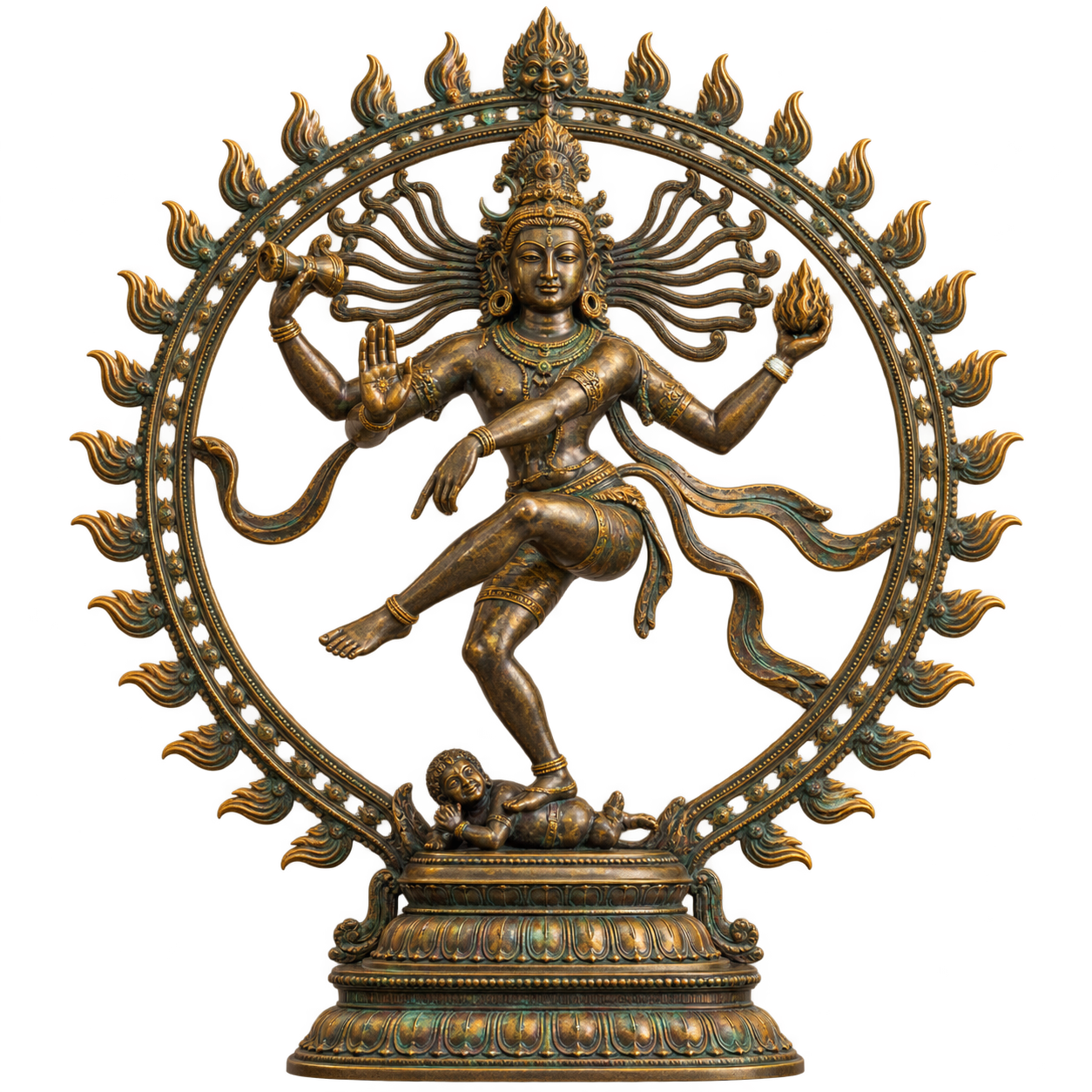
Classical dance artists gather in Chidambaram for this separately organized festival. An original bronze Nataraja within a golden ring, with salangai ankle bells, evokes its devotion to dance. Consult the organizer for the current venue and programme.
The wider sacred year includes Annabhishekam at Moolanathar on Aippasi’s full moon.
These are original festival interpretations. Chariot colours, proportions and symbolic arrangements are artistic, rather than replicas of particular vehicles or ceremonies. Sources are collected below.
11 / EVERYTHING RETURNS
திருச்சிற்றம்பலம்
The halls return. The towers hold their places. The temple becomes whole again.
Dance and stillness. Presence and space. A sanctuary at the center, and generations of life around it.
Thillai is not only a monument to look at. It is a place where worship continues.
Carry a thought with youA THOUGHT TO CARRY WITH YOU
Beware of what
you ask for.
You might just receive it.
திருச்சிற்றம்பலம்
Find your way to ThillaiTHE JOURNEY CONTINUES
சிதம்பரம், தமிழ்நாடு
Thillai Natarajar Temple
Chidambaram, Cuddalore District
Tamil Nadu 608001, India
11.399569° N 79.693558° E
Directions in Google MapsExplore on OpenStreetMapSee the daily poojas and festival seasons before planning your visit. Reconfirm ceremony times locally.
Opening the map of Thillai…
The marker identifies the temple area; use local signs for entrances.
Map tiles could not load. The OpenStreetMap and Google Maps links remain available.
ARRIVE WITH UNDERSTANDING
Let the architecture be an introduction. The life of the temple is in its worship, its language and the people who return to it.
The temple has morning and evening sessions with a midday break. If you want to attend a particular pooja, check its time on the day and leave room in your plans for the ceremony.
Festival arrangements differ from ordinary days. The seasonal guide helps you choose a time of year; the current programme gives the actual dates.
Explore the six daily poojasMove quietly around those at prayer and follow directions given at each shrine. Ask on site about photography, access and any special arrangements for that day.
The complex includes the Govindaraja Perumal shrine as well as Nataraja’s sacred spaces. This guide’s six-service sequence describes Nataraja worship; other shrines have their own rhythms.
Chidambaram Municipality ↗Chit Sabha, the sanctuary; Kanaka Sabha, the hall before it; Nritta Sabha, the chariot-shaped dance hall; Deva Sabha, associated with festival life; and Raja Sabha, the great ceremonial hall.
The model connects these places visually. Its proportions and repeated details are interpretive, so use signs and local guidance to navigate the actual temple.
Return to the temple atlasWORDS YOU MAY HEAR